
va8ty (فظتي)
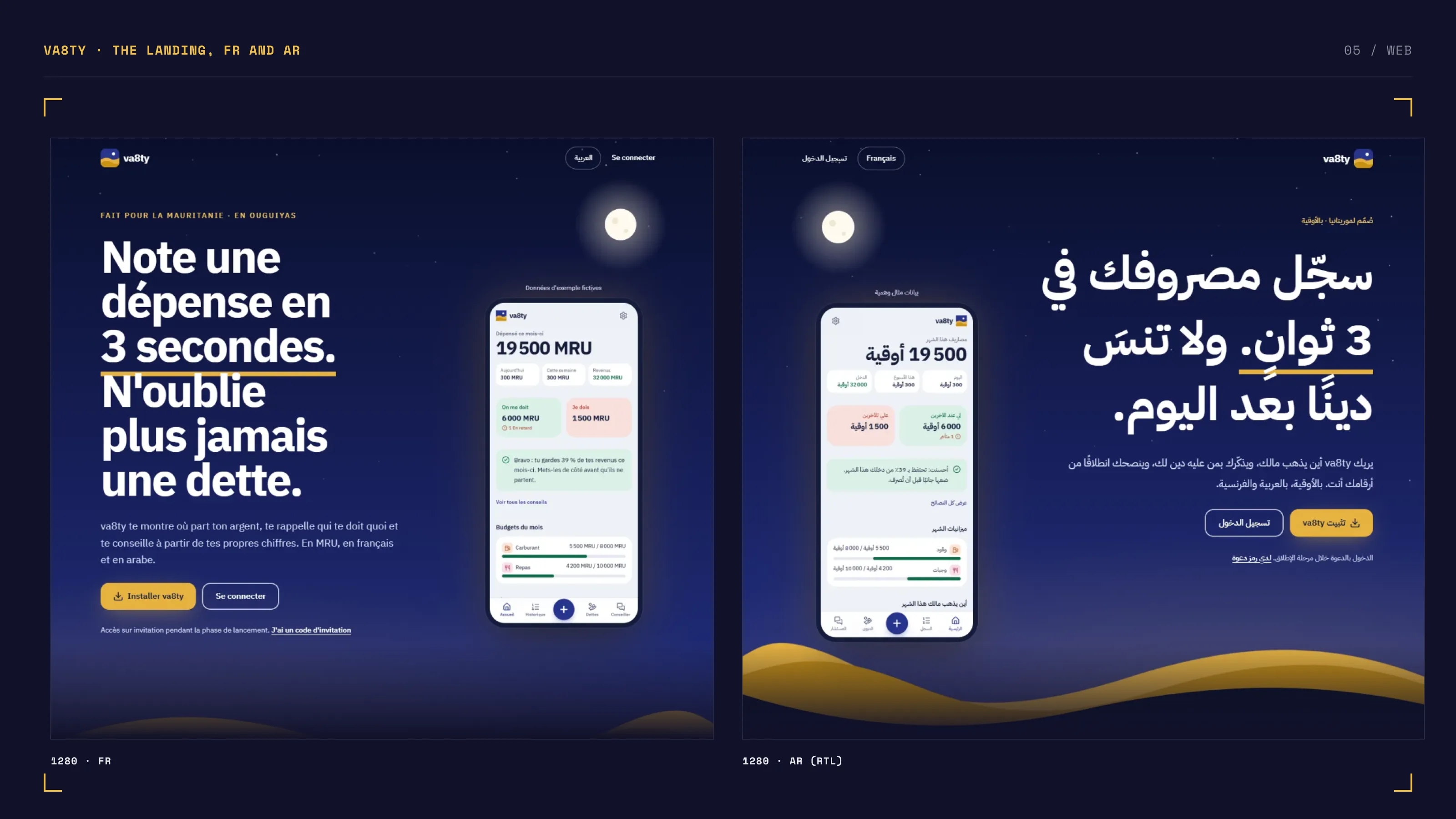
A personal finance and credit-book app for Mauritania. It keeps cash, Bankily, Masrvi and the debts between friends, family and customers in one calm place, in French and Arabic. One idea guides it: remember for people, so they don't have to.
The name. فظتي means "my money" in Hassaniya, from فضة (silver), the word Mauritanians use for money. Written va8ty, the way people type Arabic in Latin letters every day.
Visit va8ty ↗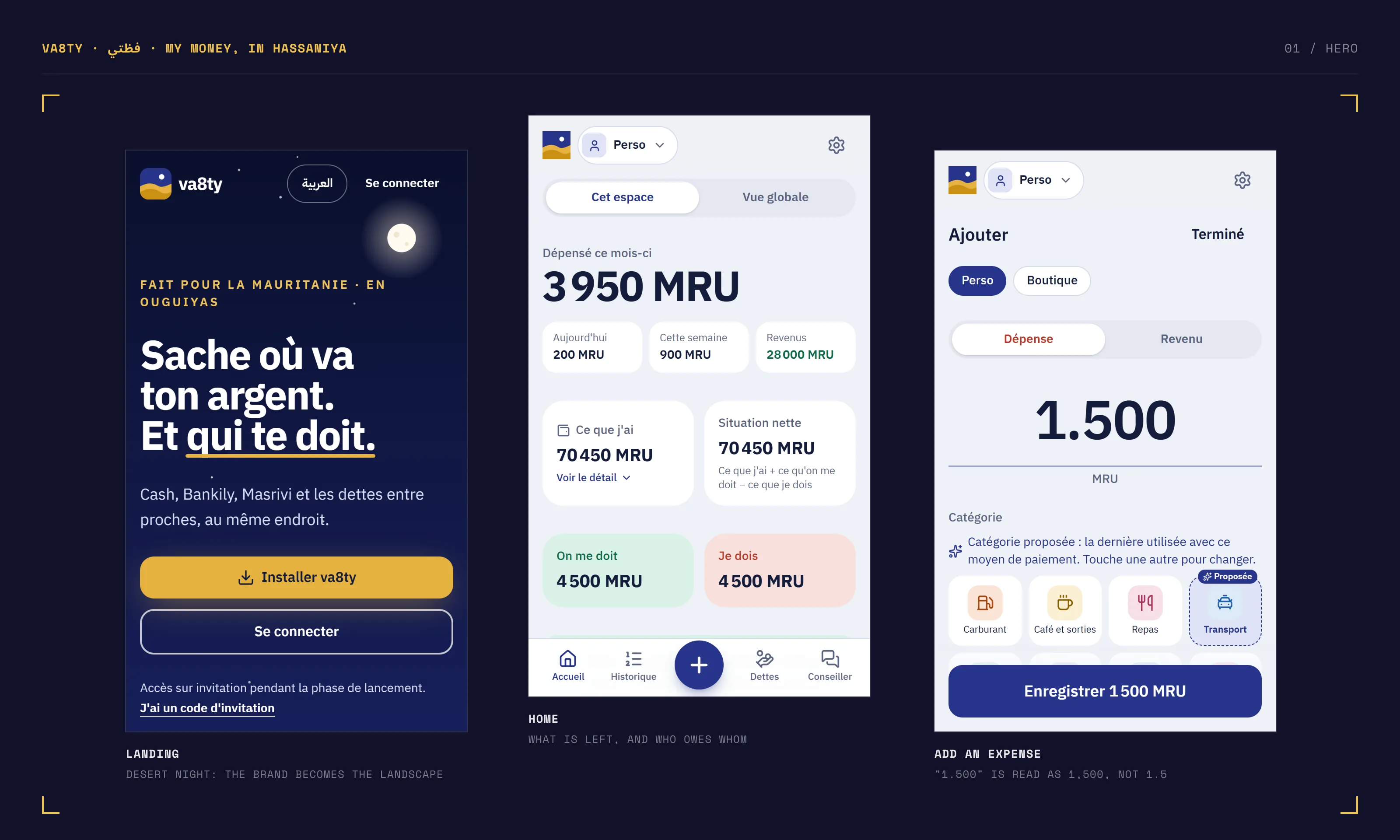
Money is scattered. Debts live in people's heads.
People hold cash, one or two mobile wallets, sometimes a bank account, and a mental list of who owes whom. Each wallet only shows its own transactions, and none of them sees cash or debts between relatives. Keeping it all in your head is tiring, and when amounts get fuzzy, debts between close people turn into arguments. Generic budgeting apps don't speak this reality: no ouguiya, no local payment methods, no Arabic that feels native.
Know where your money goes.
And who owes you.
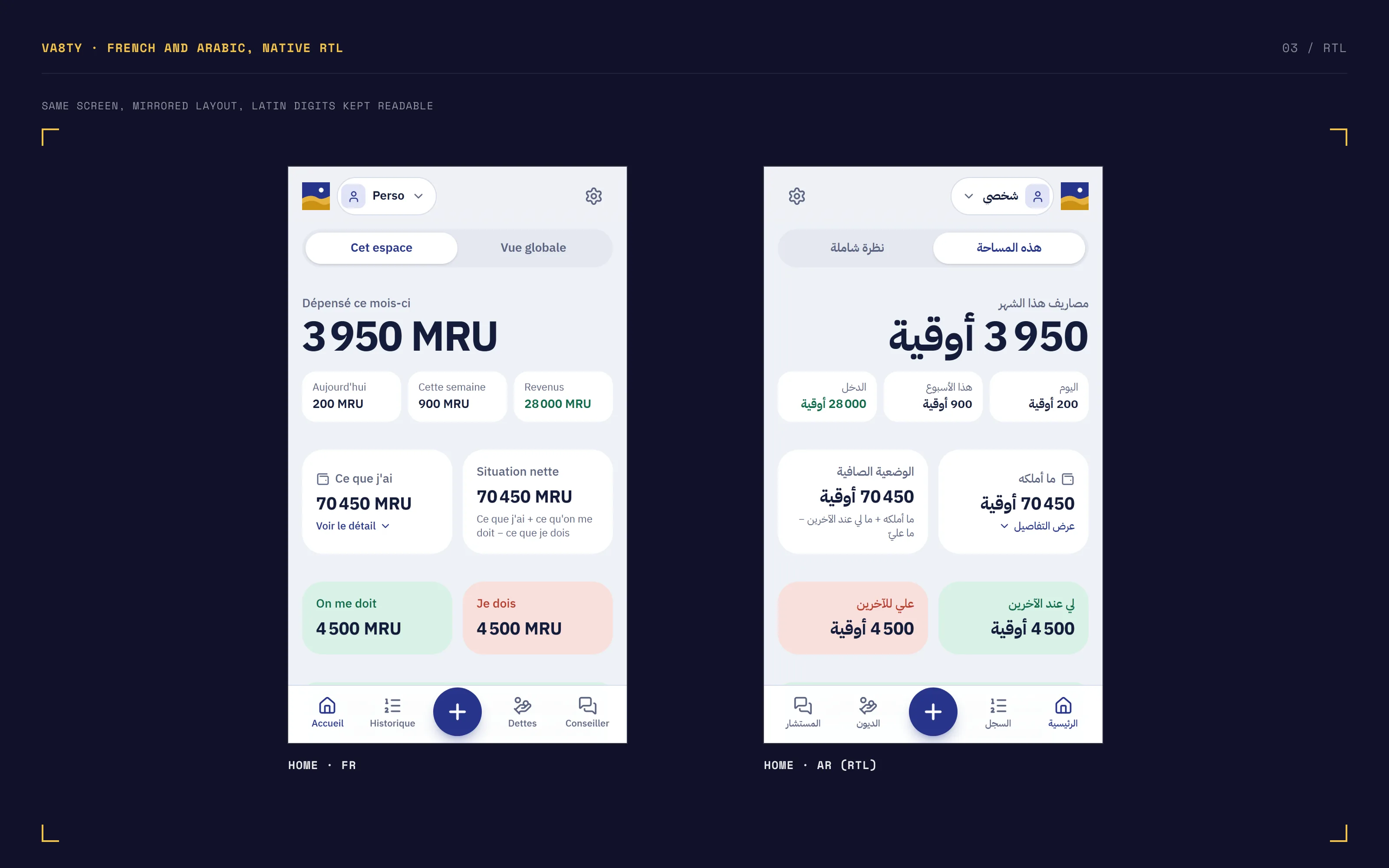
A calm notebook that remembers for you
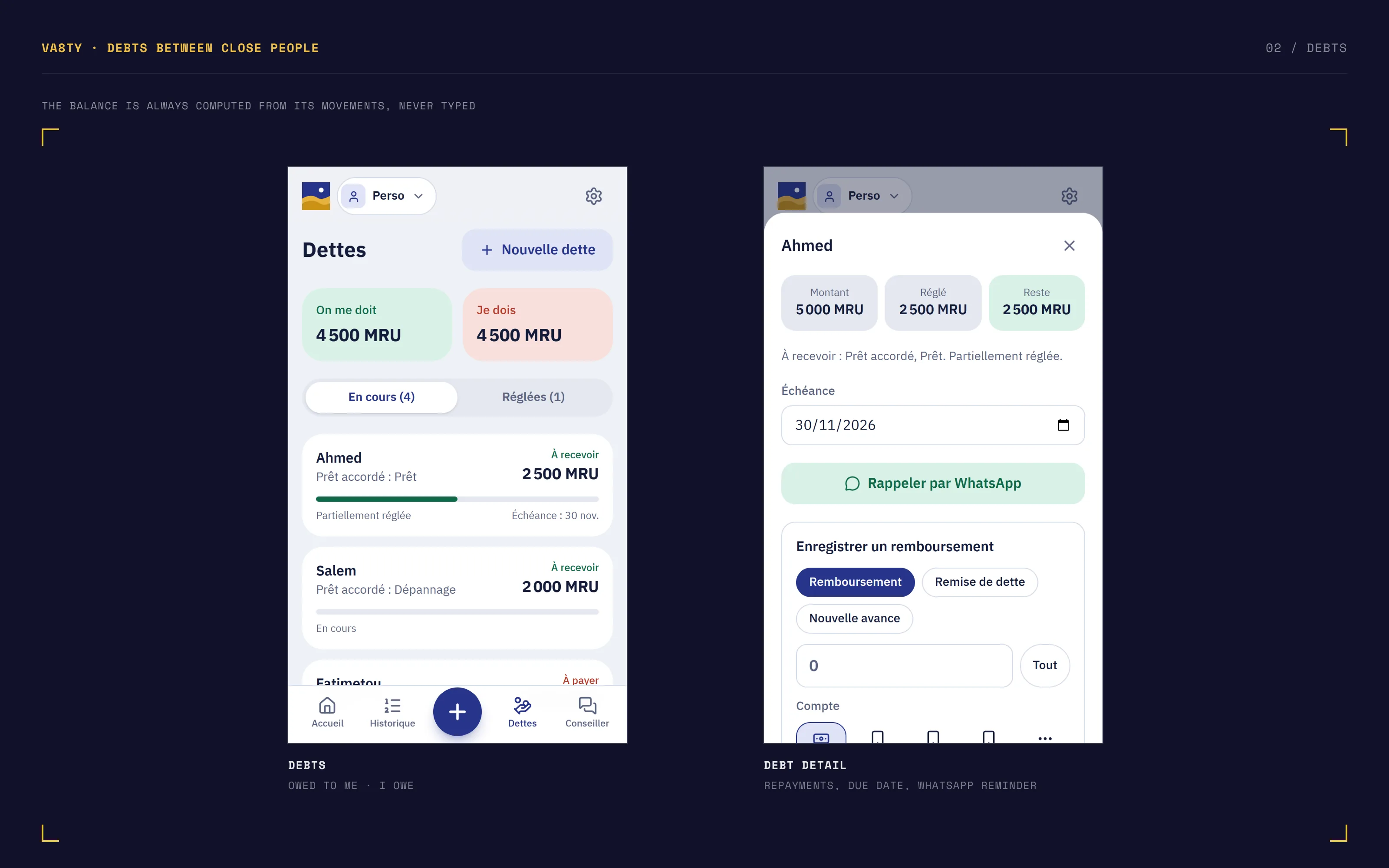
A bilingual PWA that installs from the browser. You record an expense in a few taps, track every debt with its repayments, attach a payment screenshot as proof, and see what is left at a glance. Spaces separate personal money from a small business or a project, and merchants get a credit book with polite reminders.
From a spreadsheet to a product
It started as my own Google Sheets tracker, then a Notion input space. Using it every day showed the real job: not "budgeting", but knowing what is left and who owes what, fast enough to do it daily.
Accounting rules before screens
I wrote the money rules first: a loan or a repayment is never an expense or income, a shared bill only counts your share, and a debt balance is always computed from its movements. These rules make double counting impossible by design, and 400+ automated tests keep them true.
Behavioral science, with ethics written down
I built a behavioral guardrail into the project: B.I.A.S., Fogg's B = MAP, EAST, self-determination theory, a red list of deceptive patterns, and six ethical tests every feature must pass before it ships. It has already done its job: it refused two landing-page promises the app couldn't keep yet.
Every control needs an abuse case
Login is phone + PIN, with fingerprint or Face ID passkeys, and account deletion waits 14 days. An OWASP-based audit changed how I think about safeguards: a global PIN lockout meant to stop attackers would have let a single attacker lock every user out. It became a per-IP limit with a degraded mode that never blocks a legitimate user.
Trust is the moat.
No ads, no data selling, full export, and analytics limited to anonymous daily counts with a k ≥ 5 threshold. Super admins never see a client's amounts.
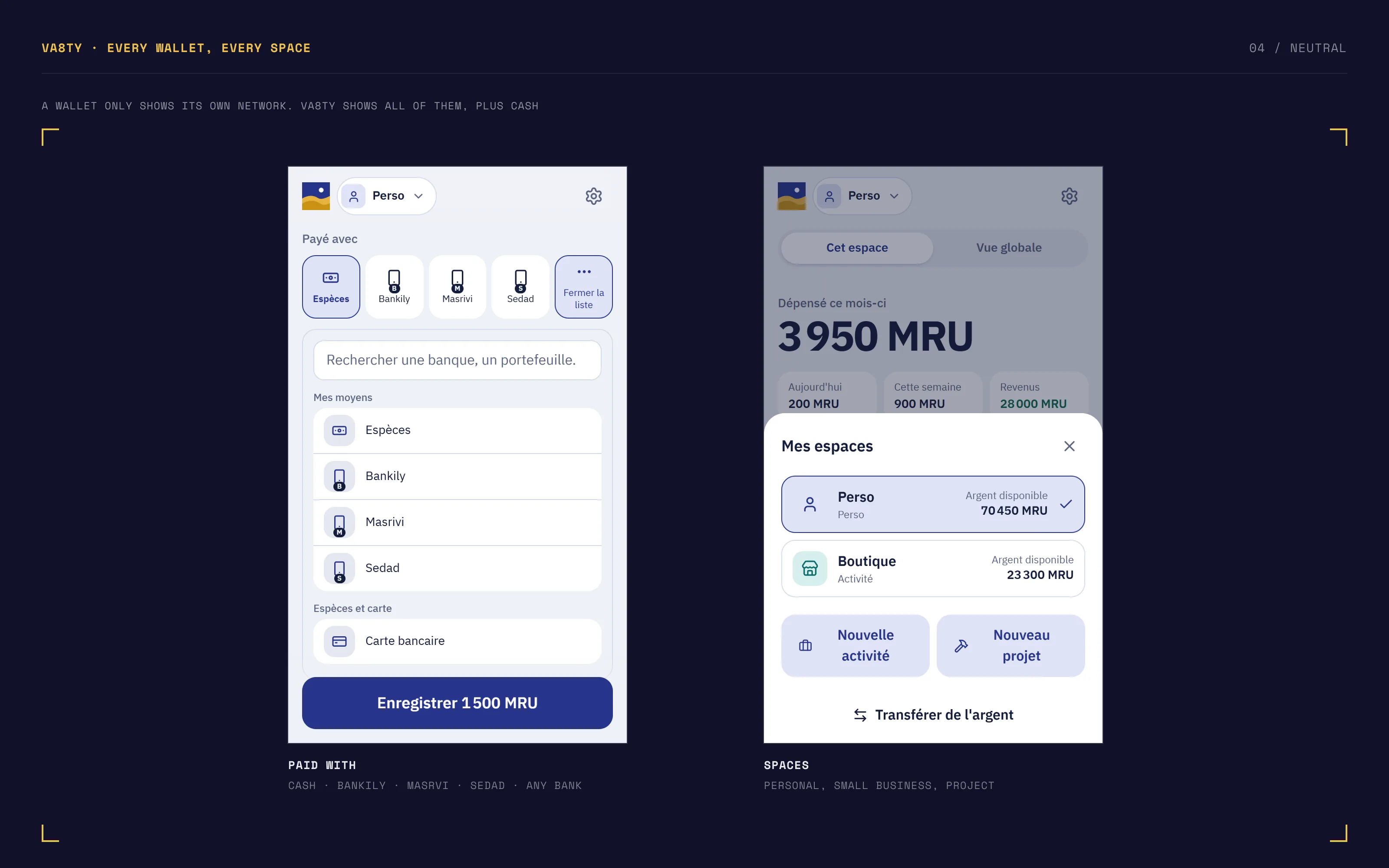
Neutral by design.
A wallet only shows its own network. va8ty shows all of them, plus cash and personal debts.
Private notifications.
Lock-screen messages never show an amount, a name or a category.
Calm over pressure.
No streaks to lose, no fake urgency, no guilt. Reminders hook onto rituals people already have, like evening tea.
Claude for product strategy, UX and security audits, behavioral research and precise implementation briefs. Claude Code for implementation under strict guardrails: secret scanning before every commit, mandatory tests, a UX review and a behavior review before any feature counts as done, and no push without my approval. Every product decision was mine.